
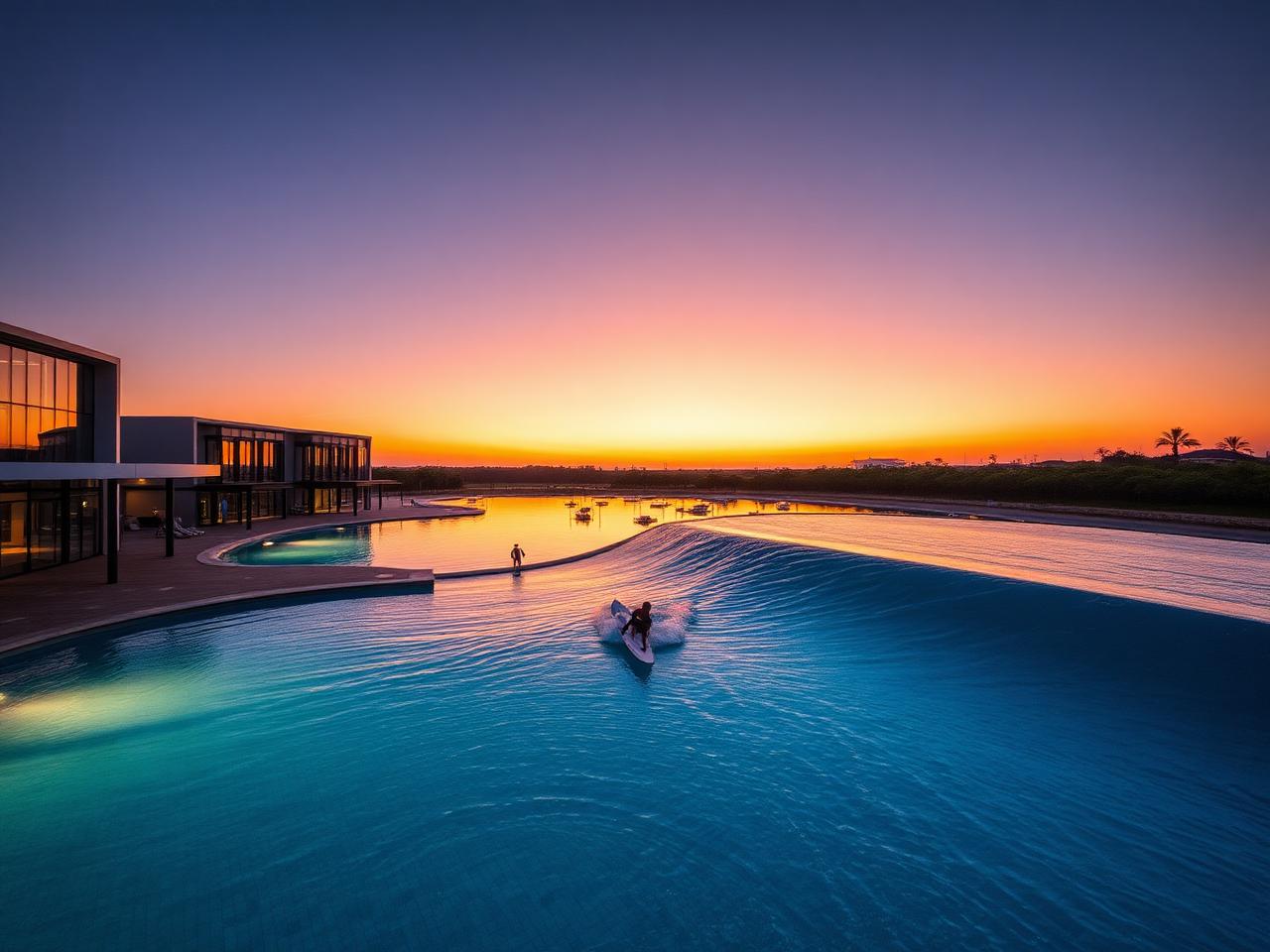
Venue 01 / 07 · Inland Surf Park
Stoke Oasis Lagoon
Programmable surf, Cape coastal soul.
Area
51,012 m²
Capacity
80-100 surfers / hour
Capital programme
R450-520M
Standard
Targeting WSL certification
The concept
Programmable surf, Cape coastal soul.
A 200-300m diamond-shaped lagoon producing up to 1,000 programmable waves per hour, from gentle whitewater for first-timers to overhead barrels for the world tour. Linked to the on-site WWTW for fully circular water use.
Inspired by: The Wave Bristol · URBNSURF Melbourne · Surf Ranch · Alaïa Bay
Build & cost profile
What it takes to build.
Extracted from the independent six-node venue analysis (August 2026). Capital ranges are the published Project Motion figures; construction programme, capex intensity and pricing are independent estimates benchmarked internationally and adjusted for South African conditions.
R450M-R520M
Estimated construction cost
24-36+ months (campus critical path)
Estimated construction time
~R9,500 / m²
Capex intensity (midpoint)
51,012 m²
Footprint
Key cost drivers
- →Imported wave-generation machinery
- →Lagoon civil works and basin lining
- →Clear-span roof envelope and interior climate management
- →Water treatment and chemistry systems
- →Energy infrastructure and standby supply
- →Interior sand beach, planting and visitor amenities
Build type
Enclosed lagoon under a clear-span roof, with a real sand beach and indigenous palms and aloes inside the envelope
Indicative entry pricing
Indicative ~R350 per 90-minute session, plus packages and memberships
Role in the campus
Primary tourism and media anchor; largest capital consumer and the programme's critical path.
Safety & emergency response
How this node is kept safe.
Extracted from the Project Motion Safety, Medical, Emergency Response & Risk Management framework (August 2026). Quantities are preliminary recommendations pending validation against the final architectural plan, occupancy modelling and applicable South African standards.
This node carries the highest emergency-readiness specification on the campus.
On-node medical provision
2 first-aid boxes · 2 AEDs · 2 mobile trauma kits
Emergency priority
RED-capable node
Principal risks
- →Drowning and near-drowning
- →Head and spinal injury
- →Collision
- →Fractures
- →Lacerations
Operating controls
- ✓Qualified lifeguard positioning with defined zones of responsibility
- ✓Wave and session capacity control, with emergency shutdown of the wave system
- ✓Water-quality monitoring protocols
- ✓Dedicated spinal-injury response and extraction protocol
- ✓Rescue equipment staged at the water's edge and direct EMS access
Required staff competencies
Lifeguard and water rescue · CPR / AED · Spinal-injury response · Emergency extraction · Water-quality protocols
Key features
What's built in.
- →Hybrid Wavegarden / KS-style wave system, 0.5-2 m faces
- →Beginner bay, intermediate point breaks, pro barrel section
- →Central viewing pier and surf-academy classrooms
- →Drone capture zones for live broadcast and content
Sustainability
How it's built green.
- ●80-90% recycled materials - ocean-plastic lining, fly-ash concrete
- ●100% renewable power via on-site solar
- ●Circular water loop via Melkbosstrand WWTW with UV filtration - an internationally proven method already used by surf parks abroad
- ●Indigenous fynbos, palm and aloe planting inside the envelope for biodiversity and interior climate
Proven internationally
Surf parks already run on recycled water.
Feeding a large surf or recreational lagoon from treated, reclaimed water is established practice, not an untested idea. Several of the world's leading surf parks already do it.
Wavegarden facilitySpain
Draws make-up water from the local municipal treatment plant's filtration system to offset evaporation losses from the lagoon - the same pipeline principle proposed here.
Adventure Parc SnowdoniaWales
Fills its surf lagoon from recycled outflow water and disinfects with UV rather than chlorine.
URBNSURF MelbourneAustralia
Runs on harvested and treated stormwater from an adjacent catchment system, cutting potable water use.
Surf Ranch, LemooreCalifornia, USA
Operates a lagoon of roughly 15 million gallons on a filtration, UV and chlorine treatment train at full commercial scale.
The facilities below are public industry reference examples only. Project Motion has no agreement, partnership or relationship of any kind with any of them.
Safe for human use
Treated to a standard set for people to swim in.
A regulated category, not an experiment
Tertiary-treated recycled water for recreational water bodies is a defined, permitted use. California's Title 22 recycled-water rules and the equivalent Australian guidelines both set standards for lake fill and landscape impoundments, and South African use would be licensed and monitored under Department of Water and Sanitation and City of Cape Town conditions.
Off-the-shelf treatment train
Multimedia filtration, UV disinfection, residual dosing and continuous turbidity and microbiological monitoring are standard, proven equipment specified daily for public swimming water. Nothing in the proposed plant is unproven technology.
Full-contact water quality
The lagoon is designed to meet full-contact recreational water standards - the same class of standard applied to public pools and swimming beaches - with automatic monitoring and shutdown thresholds set by the water engineer appointed at design stage.
What it means for a surfer
By the time water reaches the lagoon it has been treated and disinfected to a standard set for people to swim, surf and be fully immersed in, and it is tested continuously while the venue is open.